
Earlier, people often used to search around by typing their queries, which might feel complex to many people around, or we can call these people often digital immigrants. As we are evolving in the digital marketing landscape, people can use voice search engines to explore sites. Voice assistant marketing leverages AI-powered tools like Google Assistant, Siri, and Alexa, and helps users by allowing hands-free, faster, and conversational, natural language queries. They improve user experience by enabling multitasking and providing instant, often location-based, answers to spoken questions.
So the question is, what makes users engage with voice search engines? What is the future of voice search SEO? Will voice cover work be replaced by AI? There must be a list of questions that you are looking to be answered! Don’t worry, in this article we have covered how Voice search optimization can manage multiple queries at once, and how it impacts digital marketing.
What is Voice Search?

Voice search is a search engine where users can search their queries rather than typing. These voice search techniques can provide instant support, mostly answers for local searches around. Like, best restaurants around me? How can I reset my phone passwords? Which online courses are best for digital marketing?! And more.
But you must be thinking, how does it work? So it works as technology detects the user’s language, analyses keywords, context and responses verbally. It is widely used on smartphones, smart speakers, and computers. It provides hands-free convenience, accessibility for individuals with disabilities, and faster input compared to typing.
Do you know voice commerce trends are expected to reach over $150 billion by the end of 2026? Voice search is not a digital tool, but a fundamental shift towards AI, acting as personal assistants that understand context, intent, and natural language to provide instant, hands-free answers.
Now, let’s move forward and learn how these voice searches in AI play a critical role. Let’s explore!
Role of AI in Voice Search

AI in digital marketing uses artificial intelligence, machine learning, and data analytics to automate tasks, personalize consumer experiences and optimize campaigns in real-time.
Without an AI integration, voice search would just be a tool, rather than being a smart assistant tool. Here’s a list provided how AI roles in voice search;
Speech Recognition
Let’s picture this to understand: You search through a speaking voice search for the best restaurants near me, the search engine provides you with a list of the top 5 restaurants near you with text.
AI-powered speech recognition can understand your voice intent, content and deliver it to you in the form of text. Modern systems are highly accurate and can understand different accents, tones, and speaking speeds.
Key benefits:
- Hands-free operation and mobility
- Enhanced customer service
- Increased productivity and speed
Natural Language Processing (NLP)
Natural language processing allows machines to understand the meaning behind words, not just words themselves. This helps to deliver results according to queries related.
Key benefits:
- Automation of repetitive tasks
- Enhanced customer experience
- Increased data analysis and insights
Machine Learning
Machine learning helps voice systems learn from past interactions and improve over time. It becomes more accurate with repeated use and identifies patterns more quickly in user behaviour.
Key benefits:
- Data-driven decision making
- Proactive predictive maintenance & analysis
- Automate repetitive tasks
Contextual Understanding
AI does not just process single questions, but it understands context across multiple questions. Suppose you ask who the president of India is? It will provide answers with name, age, behind-the-scenes stories of how he became and more. This will help users understand more clearly.
Key benefits:
- Better risk management
- Accurate communication
- Highly-personalized experiences
Personalization
AI enables personalized experiences according to user behaviour, location and preference. This lets users to understand with more clarity, and data facts, which enables trust among users.
Key benefits:
- Improved user experience and engagement
- Enhanced customer loyalty and retention
- Stronger brand reputation
Voice Assistants Integration
AI powers popular voice assistants like Siri, Alexa, and Google Assistant. It allows users to set reminders, play music, and work more like IoT devices.
Key benefits:
- 24/7/365 accessibility and support
- Enhanced customer experience
- Improved efficiency and productivity
Predictive Search & Smart Suggestions
With adapting user preference and studying repetitive tasks, AI can predict what users could ask next. They know what you might text next, analyse your past datasets, and answer by studying all that.
Key benefits:
- Enhanced user experience
- Increased conversions and revenue
- Hyper-personalized suggestions
Growth of Voice Search
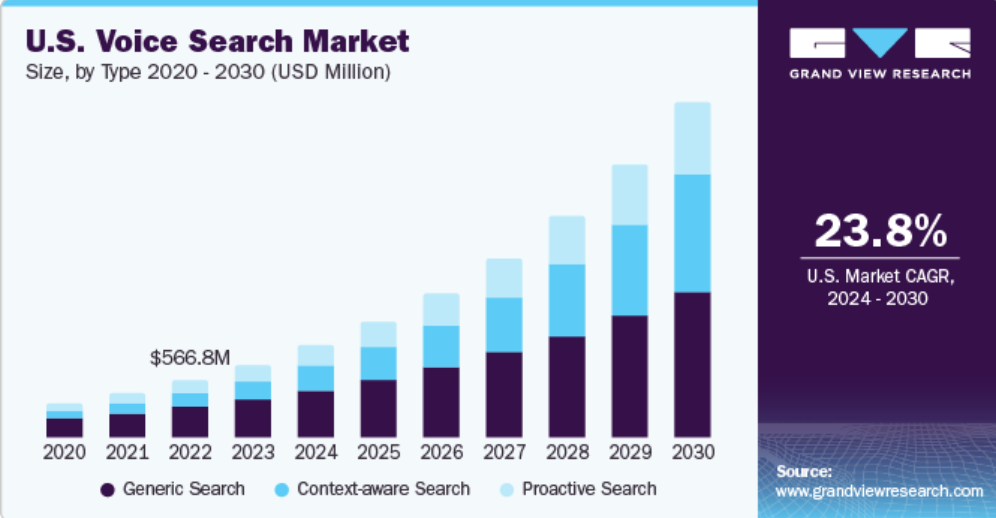
Voice searches have evolved from being just a tool to an interactive tool that delivers results based on analysing past datasets and users’ preferences. Did you know 20.5% of global internet users actively use voice searches? This means 1 of 5 people relies on voice searches.
But have you ever wondered what made this percentage rise? This technology has spread from smartphones and smart speakers to smart televisions and wearables. Voice technology is everywhere. People often rely on voice searches due to instant responses, understanding their intent, and more. This lets users engage more.
Now, let’s move further and know how voice search plays a crucial role in users’ lives.
How Voice Search is Changing User Behaviour

Voice searches have shifted users to wholly rely on the digital world. Earlier, users used to search through keywords, integrating so that search engines could understand it better, but now users can simply speak and search their queries. This shift towards natural language queries reflects broader trends of users seeking quick, direct answers to their questions.
Voice searches are becoming popular amongst users as they can easily multitask, like cooking, playing, and driving with hands-free searches. Moreover, voice search is fostering a more dynamic interaction with technology, as users expect more personalized and immediate responses tailored to their unique needs and contexts.
Impact on Digital Marketing
Voice search, driven by AI assistants, has shifted digital marketing towards conversational AI marketing like long-tail, local-focused strategies, with nearly half of searches now voice-based.
Below we list some of the impacts it includes;
- Conversational Keyword Shift: Voice queries are longer, more conversational, and often phrased as questions rather than short keywords such as, best boutique shops near me?.
- Local SEO Dominance: Voice search is heavily localized, making updated local listings, location-specific keywords, and NAP(name, address, and phone) consistency essential.
- Rise of Featured Snippets: Voice assistants frequently pull from Google’s “position zero” (featured snippets) to answer questions directly, making content concise vital.
- Content Optimization: Content should be structured to answer common questions explicitly, often requiring FAQs and conversational blog formats.
- Technical SEO & Speed: Users often search through mobile, they engage with sites which load in less than 2 seconds, and mobile-friendly optimisations are mandatory to prevent high bounce rates.
Voice Search Optimization Strategies
Voice search optimization is the process of adjusting digital content for spoken queries, which are typically longer, conversational, and question-based. To rank well, prioritise keywords based on content, focus more on mobile-friendly, fast-loading sites, implement structured data, and create FAQ pages that provide direct, concise answers.
Key Voice Search SEO Strategies
- Prioritize long-tail keywords and natural language phrases rather than short, choppy keywords.
- Structure your content with how, when, why, and what around phrases. This type of FAQ content is highly effective for ranking.
- People trust sites that describe their business on Google Business Profile, like name, address, and phone numbers.
- Most voice searches occur on mobile devices; fast-loading, mobile-friendly websites are essential for ranking.
- Implement structured data like Schema markup to help search engines understand your location and services, improving visibility in voice results.
Future of Voice Search & AI
Voice search is reshaping from being just a digital tool to smart AI assistants, driven by advanced natural language processing and contextual understanding.
By the end of 2026, we will witness AI-powered search trends as AI will act as a personalized assistant, managing complex tasks, integrating into IoT devices and shifting SEO from keywords to conversational, authority-driven answers.
In the future, voice search is expected to become an essential, everyday utility with the market growing rapidly as AI provides more accurate, empathetic, and useful assistance with investments and uses accelerating.
Final Thoughts
Voice search isn’t the future; it’s already here. With the rise of AI search algorithms and Smart speaker search optimization, digital marketing is becoming more human than ever.
If your content sounds real, helpful, and easy to understand, you’re on the right track.
If it doesn’t… it might be time to rethink your approach.