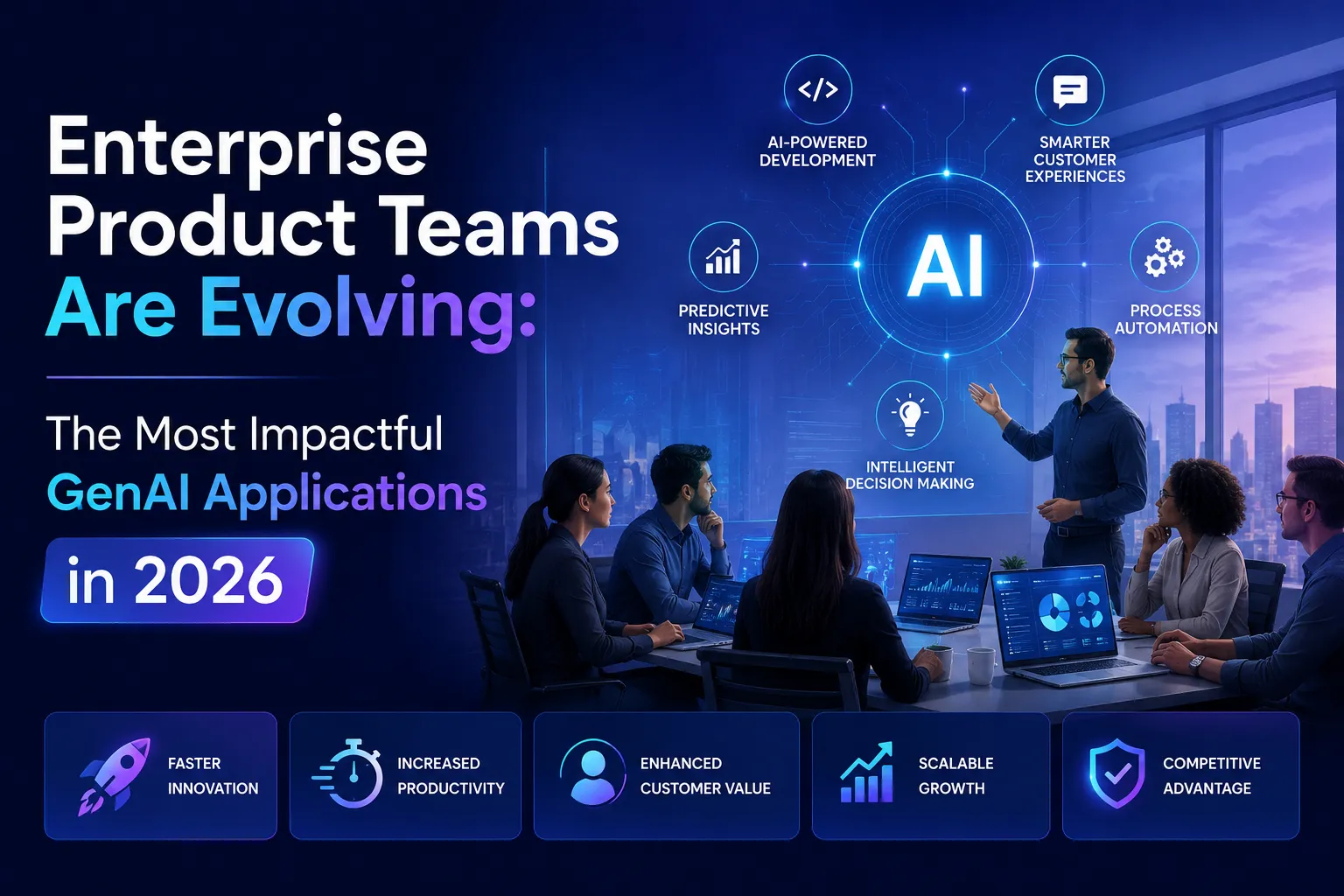
Today, product organizations see Generative AI as more than just a “science experiment.” By 2026, the most impactful Generative AI Applications in 2026 are expected to become a strategic priority for organizations focused on improving productivity, accelerating product development, automating workflows, and enhancing customer experiences.
Unlike previous AI adoption trends, this transition is taking place as companies are moving beyond the proof-of-concept stage and will instead focus on scalable implementations, measurable business value, and long-term integration of AI. As a result, AI is no longer only about building models; it is now about creating solutions that can provide a tangible business impact.
The Growing Demand for Generative AI Applications

Applications using Generative AI are becoming important to many companies as part of their digital transformation; they address actual issues and/or needs. Companies are using Generative AI for a variety of functions, including intelligent search, automating customer service, creating code and content, improving workflows, performing document analysis, and enterprise knowledge management.
Businesses find value in these applications because they help them to be more efficient by reducing the amount of time that employees have to spend on repetitive tasks (i.e., doing manual work). Therefore, employees can spend more time on strategic and creatively driven work. As such, companies can produce productivity improvements across a wide range of areas, including customer support, software development, marketing, operations, and HR.
Moreover, customers expect that companies will respond to them faster and provide them with the ability to interact with businesses in a personalised way, and offer them a smarter overall digital experience. Empowered by GenAI applications, businesses can address these customer expectations by providing real-time assistance, offering a conversational interface, and allowing for a more contextualised automated response.
Why Product Teams Are Investing More in AI Infrastructure
Enterprises are seeing that as Generative AI grows and enterprises adopt more AI technology, building AI-based features is only part of the overall problem. The sustainability and success of AI implementations are highly dependent on the existence of robust AI infrastructures, governance, scalability capabilities, and ongoing optimization efforts. As a result, product teams have begun to invest in systems that will facilitate the various processes involved with delivering AI solutions, including data preparation through to model development/ training/ deployment/ monitoring/ improving.
One of the main reasons behind this shift is the need to move quickly and innovate at scale. Enterprises are building AI-native engineering teams to speed up development, grow their capabilities without constantly increasing team size, and improve overall productivity. They are also using autonomous AI agents that can assist with coding, testing, and deployment, making the entire software development process more efficient and streamlined.
Enterprise leaders have recognized that if AI systems are not implemented using a systematic lifecycle framework, they are likely to become unreliable, costly, and/or challenging to scale. As such, enterprises are prioritizing their choice of platforms/workflows that standardize the management of all AI operational efforts performed across multiple teams/departments.
Why Enterprises Are Investing More in Generative AI Applications

Enterprise product teams are prioritizing Generative AI Applications because they provide practical business value across multiple operational areas.
- Faster Product Development
With Accelerated Product Development using generative AI technologies, product teams have been able to reduce their timelines significantly by utilizing generative AI tools for various purposes (e.g., code suggestions, debugging support, documentation generation, and testing). In this way, engineering teams can quickly develop and deploy features while reducing the rate of repetitive manual tasks.
- Improved Operational Efficiency
Many organizations continue to spend a significant amount of time performing repetitive operational activities. GenAI Applications have been able to automate many of these activities (e.g., generating reports, handling customer queries, summarizing documents, approving workflows, and communicating internally), allowing teams to focus on more strategic work rather than administrative processes. Operational efficiency helps in making decisions on a faster and more informed basis.
- Better Customer Experiences
Today’s customers expect fast responses and personalized interactions. By utilizing AI-powered assistants and chatbots, organizations can deliver real-time assistance to customers while providing consistency in their interactions. As a result, organizations can improve the level of customer satisfaction with their services while reducing their reliance on manual operations for support services. This helps in improving the customer experience and results in better customer retention.
- Smarter Decision-Making
While enterprises generate large volumes of data every day, it often takes a long time to extract useful insights from that data. GenAI Applications provide teams with the capability to more efficiently analyze data, summarize reports, identify trends, and provide assistance in making context-based decisions.
- Scalability Across Departments
One of the biggest advantages of Generative AI Applications is that they are not limited to a single department. Marketing teams can use AI for content generation, HR teams can automate employee support tasks, finance teams can streamline reporting, and operations teams can improve workflow management. This cross-functional scalability makes AI adoption more valuable at the enterprise level. AI-native engineering is evolving quickly, and enterprises are already preparing for the next wave of innovation. In the coming years, software development will become even more intelligent, automated, and data-driven. These trends will shape how AI-native teams work and how businesses build products.
The Shift from Experimentation to Long-Term AI Strategy
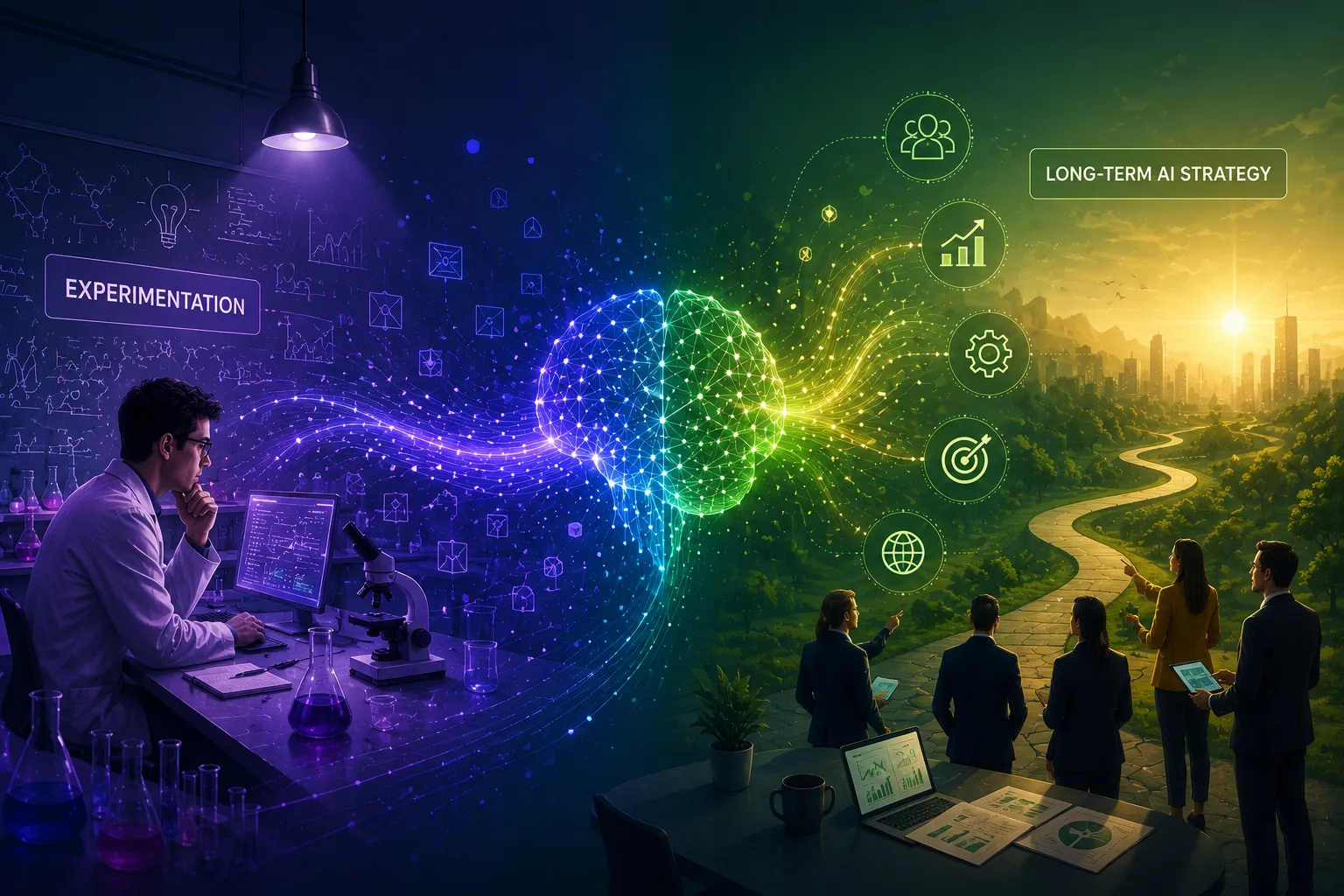
Many businesses were experimenting with AI in the past; however, there has been a large transition in how companies view AI since 2026. Enterprises are no longer experimenting with AI through small, isolated projects. They are implementing AI through corporate-wide policy and operational strategies that create the foundation of scaling future innovation and operational efficiencies.
Product Teams are no longer debating whether to develop new GenAI applications, but rather how to implement GenAI sustainably into products, processes, and the Enterprise Eco-System.
The core drivers of the shift are: Initial enterprise adoption was characterized by inflated expectations. Today, organizations are hyper-focused on tangible business outcomes rather than just the novelty of generative AI.
Speed of Deployment: With speed recognized as a distinct competitive advantage, 91% of business leaders emphasize rapid deployment, prompting a pivot from building proprietary models to scaling off-the-shelf capabilities.
Resilience and Scale: Business leaders are pivoting from single-process automation to embedding AI deep within their operating cores to drive autonomy and systemic resilience
Conclusion
Enterprises are rapidly adopting AI by 2026 because the value generated from Generative AI Applications is becoming increasingly measurable across industries, from workflow automation and intelligent assistants to customer engagement and software development support.
To properly deploy AI, businesses must support the entire lifecycle of data management, model deployment, governance, monitoring, and optimization. Enterprises are not just adopting AI but are actively reshaping their teams and workflows to become AI-first. Building AI-native engineering teams requires a structured approach that combines the right talent, tools, and processes. Instead of relying on traditional methods, companies are creating environments where AI is part of everyday development.
Companies that treat Generative AI Applications as a long-term strategic investment rather than a short-term experiment will be better prepared to scale AI initiatives, drive innovation, and compete successfully in an increasingly AI-driven world.