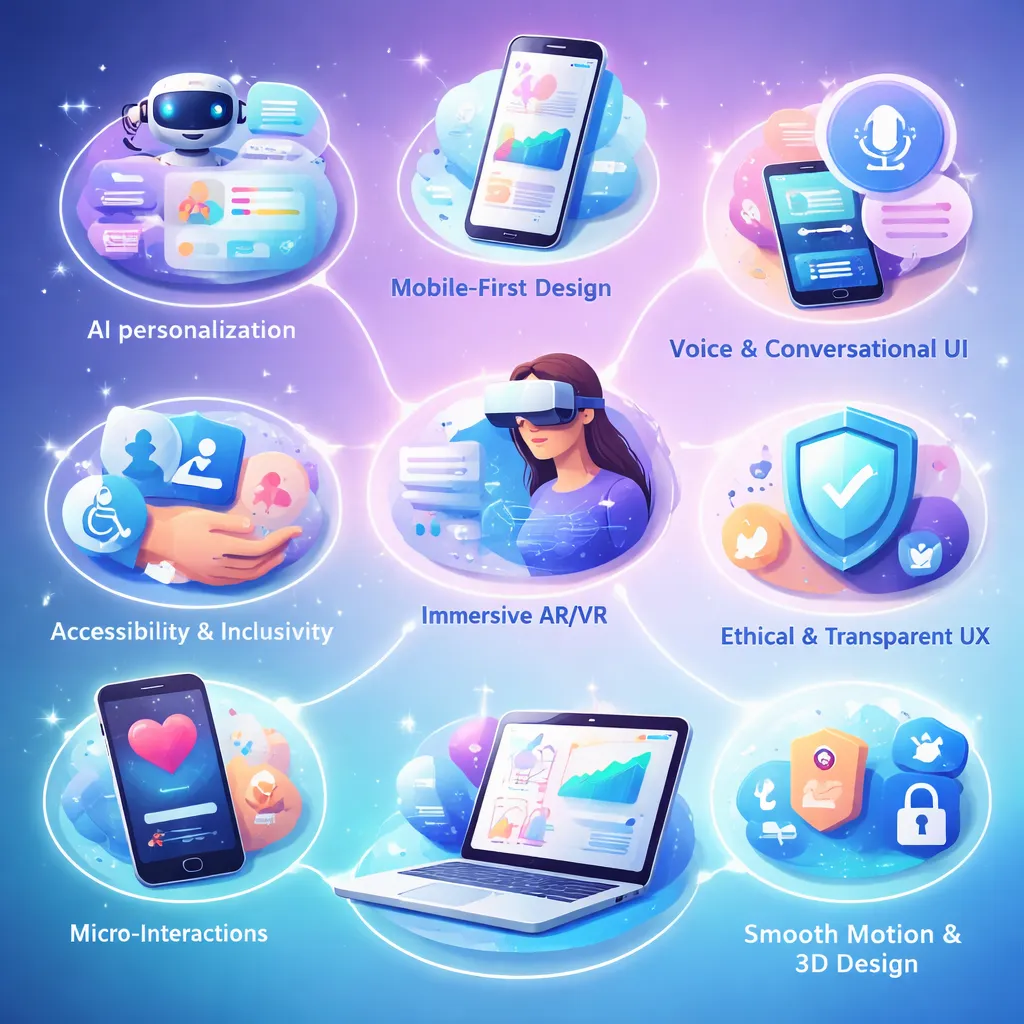
In 2026, UX teams are flooded with AI promises, smart assistants, and shiny UI patterns, but users’ expectations have quietly shifted. They want products that feel trustworthy, respectful of their time, and genuinely easy to live with day after day. The latest user experience design trends of 2026 point in the same direction: AI matters, but only when it serves clear user needs, fits into real contexts, and supports long-term usability instead of just short-term “wow” moments.
For businesses, this means stepping back from the AI hype cycle and asking a more grounded question: “How can we design experiences that people will still want to use two years from now, not just two weeks after launch?”
Why the latest UX trends of 2026 matter for real business outcomes
The latest UX trends of 2026 are not only about fresh visuals or futuristic prototypes.
They are about reducing friction in journeys, increasing trust in complex systems, and creating products that people instinctively recommend to others.
When you look at brands that consistently outperform their competitors, they tend to do a few things well: they clarify choices, minimize anxiety, and design flows that feel respectful instead of manipulative.
This is why the latest user experience design trends of 2026 increasingly connect UX with core metrics like customer lifetime value, activation rates, and support costs.
- If AI features confuse people, generate errors, or hide important information, they might look innovative, but still hurt retention.
- On the other hand, a thoughtful consent flow, a clear error message, or a well-timed microcopy update can quietly cut churn and reduce calls to support.
In a market where every competitor can copy a feature within months, the depth and consistency of the experience becomes the real differentiator.
The latest UX trends: 7 examples
1. Human-centered AI as an invisible layer, not the whole product
One of the strongest UX trends of 2026 is the normalization of AI as a background layer. Users increasingly expect products to “just know” a bit more about their context: suggesting the next step, pre-filling obvious details, summarizing long content, or highlighting anomalies they should pay attention to. But they also expect control and clarity.
That is why good AI UX in 2026 avoids magic tricks that can’t be explained. Instead, it shows why something was recommended, gives simple options to refine or correct it, and uses plain language instead of technical jargon. When an AI assistant drafts a contract clause or suggests a financial move, people want to see a short explanation, a way to edit the suggestion, and a clear way to opt out of automation entirely.
2. Accessibility and inclusive UX as the new baseline
Regulation, demographics, and expectations are converging to make accessibility non-negotiable. This was already visible in 2025, and it is even stronger within the latest user experience design trends of 2026. Teams that still treat accessibility as a bolt-on are finding it more expensive and more painful to fix issues later, while teams that bake it into their design systems can move faster and ship with more confidence.
For businesses, the payoff is twofold.
- First, accessible interfaces open the door to more customers in every age group and ability level.
- Second, the process of designing for diverse needs tends to reveal usability improvements that benefit everyone, from clearer navigation labels to more forgiving form validation.
In other words, accessibility is both compliance and a competitive edge.
3. Calm, context-aware experiences instead of notification overload
Another key aspect of the latest user experience design trends of 2026 is the move toward calm and context-aware interaction. After years of push alerts, banners, pop-ups, and “are you still there?” dialogs, users are actively pushing back against products that constantly demand attention. They gravitate toward tools that quietly adapt to their day instead of interrupting it.
Calm UX doesn’t mean silent products. It means smarter prioritization and better timing.
- For instance, a productivity app that bundles non-urgent updates into a single digest respects attention more than one that sends five separate alerts.
- A health tracker that delays non-critical notifications until it detects you are not driving or in a meeting feels intelligent without being intrusive.
Context-aware design also shows up in multimodal interfaces. People may start a task on a desktop, continue on mobile, then finish via voice while driving.
4. Privacy, trust, and data ethics at the surface of the interface
Users now know that “free” apps are rarely truly free. Data, personalization, and AI training are widely discussed topics, and distrust grows whenever products hide what is really happening. That is why the latest user experience design trends put privacy and trust directly into visible UI elements instead of burying them in legal documents.
You can see this in interfaces that show why a recommendation appears, allow quick toggling of tracking options, or present privacy levels as clear choices instead of obscure checkboxes.
Short, readable explanations beat long paragraphs of legal language. Visual indicators that data is processed locally rather than sent to remote servers help users feel safer, especially with health or financial information.
For businesses, building this kind of transparent UX may initially seem like extra work, but it pays off in loyalty and reduced support friction. People are more willing to share data when they know what they get in return, how they can revoke access, and how to correct or delete information if needed. In an environment where nearly every product uses data, the ones that explain it well stand out.
5. Sustainable and “greener” UX as a brand signal
Sustainability has turned into a practical UX concern instead of a purely marketing message. The latest user experience design trends of 2026 include more efficient interfaces, reduced “bloat” in pages, and design choices that nudge users toward environmentally friendlier options. Small, thoughtful touches add up.
- For example, an e-commerce site can make slower but greener shipping the default choice while still allowing faster options.
- A streaming platform can highlight lower-bandwidth modes for users on limited data plans, which also reduces energy consumption on the infrastructure side.
- Even dark mode, when implemented thoughtfully, can contribute to lower power usage on certain screens and offer a more comfortable experience in low-light environments.
6. Immersive, 3D UX used with restraint
The latest user experience design trends of 2026 definitely include more immersive elements, from subtle 3D depth to full AR and VR scenarios. However, the attitude has matured. Instead of adding 3D or mixed reality just because it looks impressive, more teams now ask a simple question: Does this particular interaction genuinely benefit from spatial representation?
In product configuration, architecture, training simulations, and certain kinds of data visualization, the answer is often yes.
- Being able to “walk around” a layout or rotate a product helps people make faster, more confident decisions.
- In contrast, using 3D just to decorate a basic form or dashboard tends to slow the experience and drain resources.
7. Financial and everyday UX as proving grounds for trust
Money, health, and everyday utilities are where UX decisions get tested the hardest. People have low tolerance for confusion when real money is involved, so financial products often reveal which UX patterns truly work. The latest user experience design trends of 2026 show a push toward clearer language, better onboarding, and visual explanations of complex concepts in areas like investing, subscriptions, and digital wallets.
Crypto and stablecoin features, for example, are moving from specialist apps into mainstream platforms. That shift forces teams to explain ideas like keys, custody, or transaction fees to people who have never used such tools before. Interfaces that break these down into simple, progressive steps (and that provide safe defaults) have a better chance of winning trust.On the more familiar side of banking and budgeting, there is a rise in family-oriented UX: shared accounts with flexible permissions, simple goal setting for multiple people, and dashboards that show who can access what. These patterns then influence adjacent industries, pushing more apps to support shared identities, multiple roles, and transparent activity histories.