For most of the past decade, enterprise-scale automation was exactly that: enterprise-scale. The technology existed, the ROI was real, but the cost of implementation, the complexity of integration, and the need for dedicated technical staff to manage the systems put it out of reach for businesses operating below a certain revenue threshold.
That barrier is gone. AI agents have democratized automation in a way that no previous wave of business technology has. A small business with ten employees can now deploy the same category of intelligent automation that a corporation with ten thousand employees uses to run its operations, at a cost and complexity level that makes the investment genuinely practical.
What that means for competitive dynamics is significant. The businesses that recognize and act on this shift are building operational capabilities that their competitors, who are still running on manual processes and disconnected systems, cannot match on speed, consistency, or cost. The businesses that wait are watching the gap widen.
Quick Summary
- AI agents give small businesses access to enterprise-level automation capabilities without the enterprise-level infrastructure investment
- The operational advantages of AI agents, including speed, consistency, and 24/7 availability, translate directly into competitive differentiation in customer-facing and internal functions
- Small businesses that deploy AI agents in the right workflows free their teams to focus on the high-value work that actually requires human judgment and relationship skills
- The window for early-mover advantage in AI agent adoption is open now and will not stay open indefinitely as adoption accelerates across industries
Why the Competitive Landscape Is Shifting Right Now

The competitive advantage of large businesses over small ones has historically come from three sources: access to capital, access to talent, and access to technology. The third advantage is eroding faster than most small business owners have recognized.
AI agents, delivered through cloud-based platforms with subscription pricing and implementation support from experienced technology partners, have made enterprise-grade automation accessible to organizations that would have had no realistic path to it three years ago. The same technology that allows a large financial services firm to automate client onboarding, document processing, and compliance reporting is now available to a ten-person advisory practice at a fraction of the cost and without the requirement for an internal IT department to manage it.
The implications for competition are direct. Small businesses that operate in markets alongside larger competitors are no longer necessarily at a disadvantage in operational efficiency. The question is not whether the technology is available. It is whether the small business recognizes the opportunity and moves on it before the gap closes in the other direction.
What AI Agents Give Small Businesses That Manual Processes Cannot
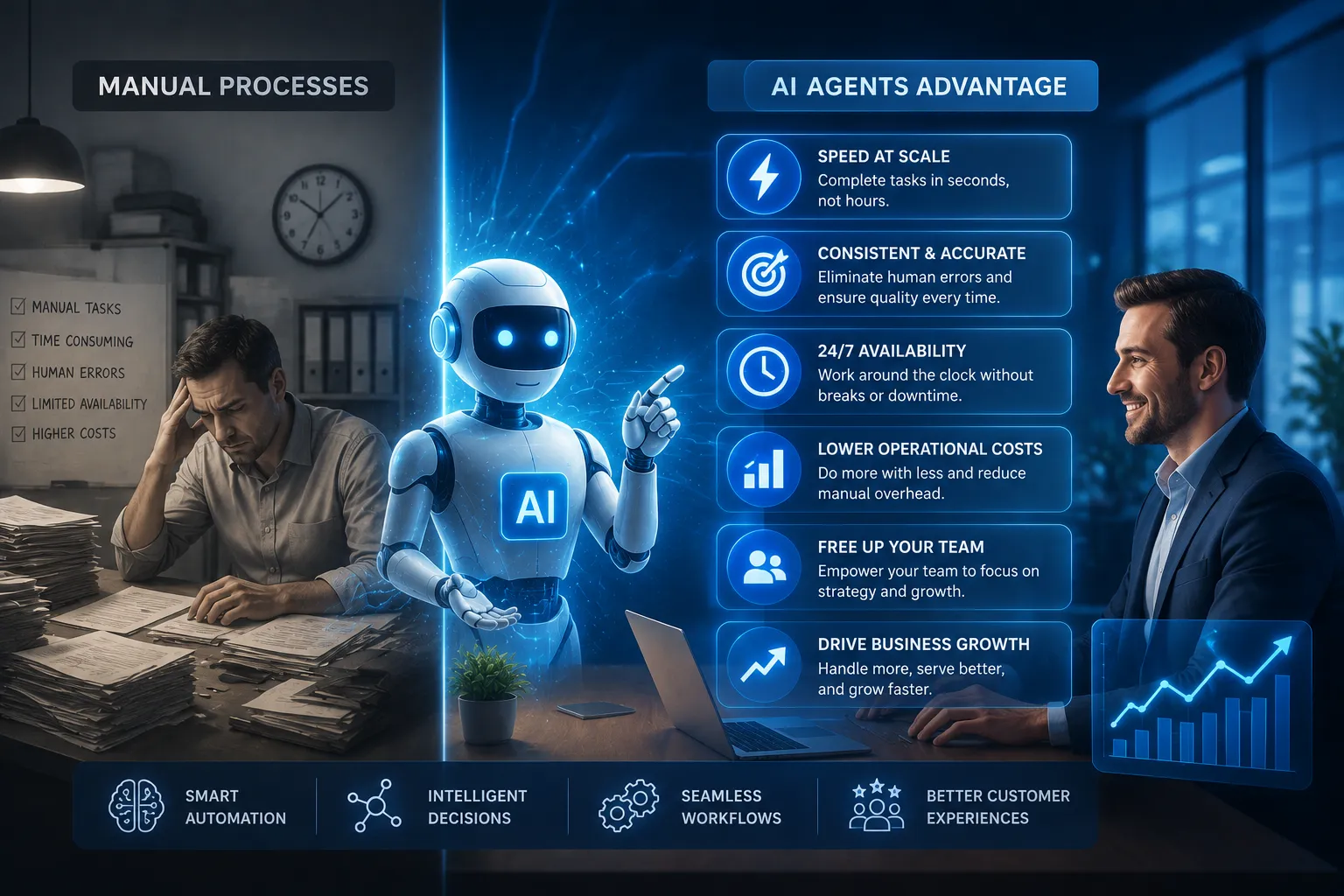
The operational advantages that AI agents deliver over manual processes are not marginal. In the workflows where they are deployed effectively, the difference in speed, consistency, and capacity is substantial enough to change how a business competes.
Speed That Does Not Scale With Headcount
Manual processes have a ceiling determined by the number of people available to perform them and the hours those people can work. AI agents do not. A small business that deploys an AI agent to handle customer inquiry responses, lead qualification, or invoice processing can handle three times the volume without adding a single staff member. That capacity advantage is not theoretical. It is operational, and it is available from the moment the agent is deployed.
Consistency That Eliminates Process Variation
Human-executed processes vary. The quality of a customer response depends on who is handling it and when. The accuracy of a data entry task depends on the attention level of the person performing it at that moment. AI agents execute the same process the same way every time, regardless of volume, time of day, or competing demands on the organization. For small businesses where a single inconsistent interaction can damage a client relationship that represents a meaningful percentage of revenue, that consistency has real business value.
Availability Without Overhead
A small business competing against larger organizations for clients who expect round-the-clock responsiveness faces a structural disadvantage when responsiveness depends entirely on staff availability. AI agents operate continuously. A prospect who submits an inquiry at 11pm on a Saturday receives a substantive, personalized response immediately rather than waiting until Monday morning. That responsiveness, at no incremental cost, changes the competitive experience for clients and prospects who are evaluating their options.
The Workflows Where Small Businesses Gain the Most Ground
Not every workflow produces equal competitive advantage when automated. The highest-value applications for AI agents in small business environments consistently fall into a handful of categories.
Customer Communication and Lead Response
Speed of response is one of the most significant factors in lead conversion across industries. Studies consistently show that the likelihood of qualifying a lead drops dramatically with each hour of delay in the initial response. An AI agent that responds to every inquiry immediately, qualifies the lead against defined criteria, provides relevant information, and schedules a follow-up with a human team member delivers a response experience that most small businesses operating on manual processes cannot match.
Administrative and Back-Office Processing
The administrative tasks that consume small business staff time, including data entry, document processing, appointment scheduling, invoice management, and report generation, are precisely the category of work that AI agents handle most reliably. Automating these functions does not just save time. It redirects the human capacity freed by that automation toward the client-facing, relationship-building, and strategic work that actually differentiates a small business in its market.
Client Onboarding and Service Delivery Workflows
The quality and consistency of the client onboarding experience is a significant driver of long-term retention and referrals for small businesses. AI agents can orchestrate the sequence of communications, document requests, system setups, and internal handoffs that constitute the onboarding process, ensuring that every new client receives the same high-quality experience regardless of which team member manages the relationship.
Monitoring and Exception Detection
Small businesses cannot afford the dedicated monitoring staff that larger organizations maintain to watch for anomalies in operations, financials, or customer activity. AI agents can perform that monitoring function continuously, flagging exceptions for human review rather than requiring staff to search for problems that may or may not be there.
How AI Agents Free Small Business Teams to Do Better Work

One of the most consistently undervalued benefits of AI agent adoption in small businesses is what happens to the people whose time was previously consumed by the work the agent now handles.
Small business teams are typically lean by necessity. The same person who manages customer communications also handles administrative tasks, supports operations, and contributes to client delivery. When AI agents absorb the repetitive, process-driven components of that workload, the team member’s available capacity shifts toward the work that requires human judgment, creativity, and relationship skills. That shift improves both the quality of the high-value work and the engagement of the team member performing it.
The competitive implication is significant. A small business whose team spends seventy percent of its time on high-value, relationship-driven work because AI agents handle the process-driven remainder competes differently than one whose team splits its time evenly between high-value and administrative work. The difference in output, client experience, and team retention is real and accumulates over time.
The Risks of Waiting While Competitors Move
The window for early-mover advantage in AI agent adoption is meaningful but not permanent. As adoption accelerates across industries, the operational baseline that clients and prospects expect from small businesses will rise. What feels like a competitive advantage today will eventually become a competitive requirement, and organizations that build operational fluency with AI agents now will be significantly better positioned when that shift occurs than those building from scratch under competitive pressure.
Beyond the competitive risk, there is an operational risk in waiting. The learning curve in AI agent implementation is real. Building institutional knowledge about which workflows benefit most from automation, how to govern AI agents appropriately, and how to integrate them effectively with existing systems takes time. Organizations that start that learning process now have the opportunity to do it thoughtfully. Organizations that start it in response to competitive pressure will be doing it under circumstances that do not favor thoughtful decisions.
What Thoughtful AI Agent Adoption Actually Looks Like for a Small Business

Thoughtful AI agent adoption for a small business is not a big-bang transformation. It is a structured, phased process that starts with the highest-value opportunity and builds operational confidence before expanding scope.
The starting point is identifying the single workflow where the combination of time consumed, consistency required, and volume processed makes AI agent automation most obviously valuable. That is the first deployment. It is scoped tightly, implemented with appropriate governance, and measured against defined success criteria before the next workflow is addressed.
From that foundation, adoption expands incrementally, with each phase informed by the operational learning of the previous one. The result is an organization that develops genuine AI agent competency rather than an organization that deployed a tool it does not fully understand or manage effectively.
The critical success factor at every stage is working with an implementation partner who understands both the technology and the operational context of the business, because the decisions that determine whether an AI agent delivers its potential value are made during implementation, not after.
How Mindcore Technologies Helps Small Businesses Deploy AI Agents
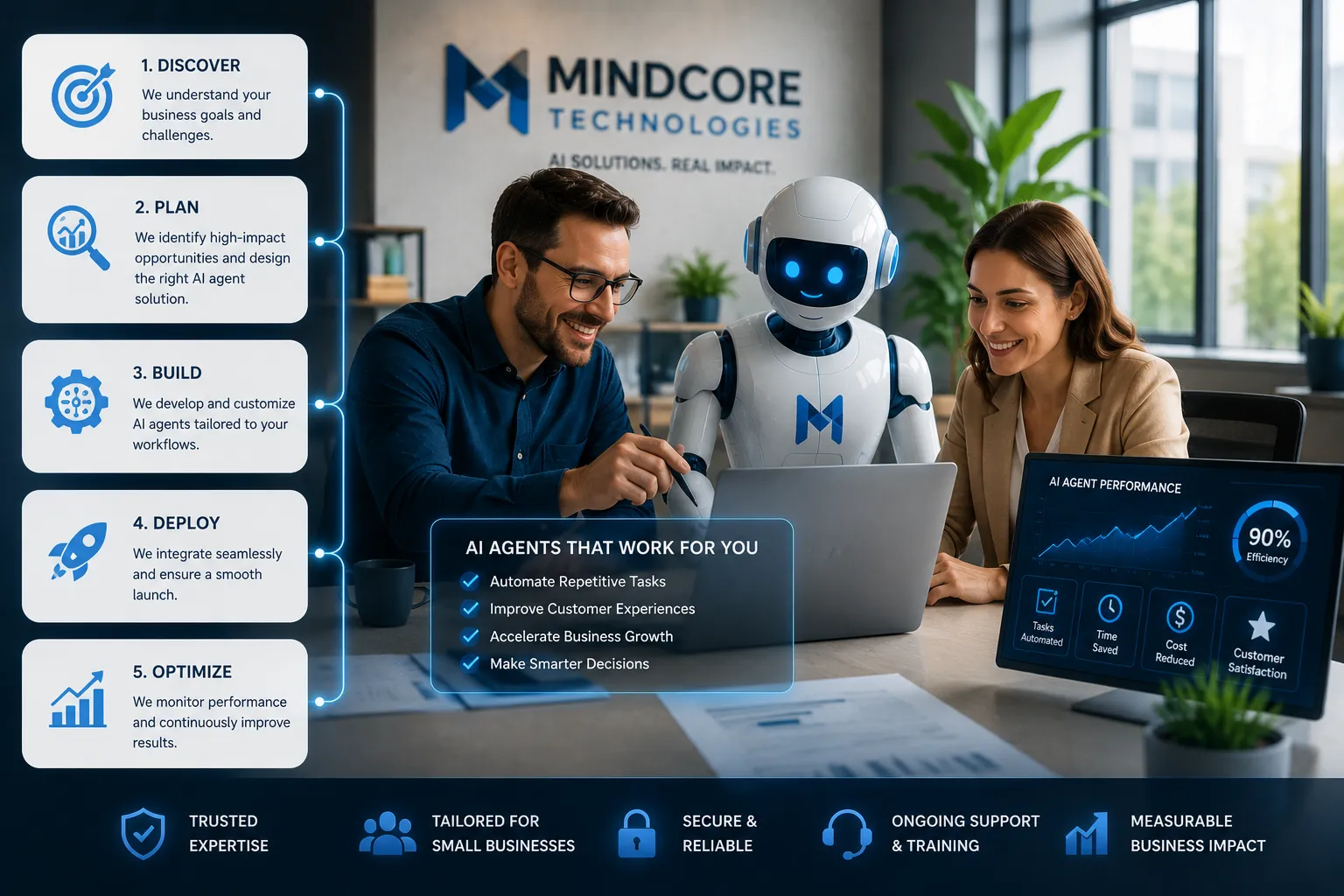
Small businesses looking for an experienced partner to guide AI agent adoption have a strong option in Mindcore Technologies.
With more than 30 years of IT consulting and technology implementation experience, Mindcore brings the operational perspective and technical depth that small businesses need to make AI agent adoption practical rather than theoretical. Under the leadership of Matt Rosenthal, CEO of Mindcore Technologies, the company delivers end-to-end AI integration and automation services that are specifically designed to fit the resource constraints, operational realities, and growth objectives of small and mid-sized businesses.
Mindcore helps small businesses identify the workflows where AI agents will deliver the highest return, build implementation plans that are sequenced for manageable adoption, and ensure that every deployment is supported by the governance and security frameworks that responsible AI adoption requires. Their approach is grounded in measurable business outcomes rather than technology enthusiasm, and their experience across industries means they bring pattern recognition from real deployments rather than generic implementation templates.
The Competitive Window Is Open Now
The small businesses that will look back on 2026 as the year they built a durable operational advantage are the ones that recognized the AI agent opportunity clearly and acted on it with a structured, expert-guided approach. The technology is ready. The cost is accessible. The competitive case is clear.
A free consultation with Mindcore Technologies is the right starting point for understanding which workflows in your specific business represent the highest-value opportunity for AI agent automation and what a practical path to deployment looks like.
Conclusion
AI agents have changed what is possible for small businesses in a fundamental way. The operational capabilities that once required enterprise scale are now accessible to any organization willing to approach adoption thoughtfully and with experienced guidance. The competitive advantage belongs to the businesses that move first, build operational fluency, and compound that advantage before the window closes.
With Mindcore Technologies and more than 30 years of technology implementation expertise behind your adoption, that advantage is within reach.